Sign up free — 100 credits, no card

Character Description Generator

A character description generator usually ends at the paragraph. Here the description is where the character starts: it is written into the cast, drawn as a character sheet, and that same sheet goes into every shot and into the next episode. Write the description yourself, or let the agent write one from a story idea.

Image
How It Works

Key Features

01

A description a picture can be drawn from

Each character is written down as a name and a description: appearance, clothing, colours and materials. That is the detail a drawing needs, not a list of adjectives. Write it yourself in the chat, or leave it to the agent and read what it wrote.

02

Fixed once it is drawn

The sheet drawn from the description is the character. It is attached to each shot the character is in, on the video models that take a reference image, so a later scene does not re-read the words and invent a new face.

03

Change one detail, keep the person

Ask for different hair, a new jacket or a scar and only that character’s description is edited. The rest of the cast and the story stay. The pictures that no longer match are listed, and redrawing them is your call.

What a character description is for

Most character description generators hand you a paragraph: a few lines about looks, a personality, a quirk. For a novelist or a game master that paragraph is the finished product, and the quick, free ones are fine for it. This page is for the other case, where you read the description and then want to see the person.

That step has a trap. Paste the same paragraph into an image generator twice and you get two people who both match the words and neither matches the other. “Short dark hair, green jacket, tired eyes” describes thousands of faces. Words describe a type; a picture is one particular person. Once a story has more than one scene, that difference is the whole problem.

In Reelfo the description is the first half of a pair. It is written into the cast, a character sheet is drawn from it, and from then on the sheet, not the sentence, is what stands for the character in every shot.
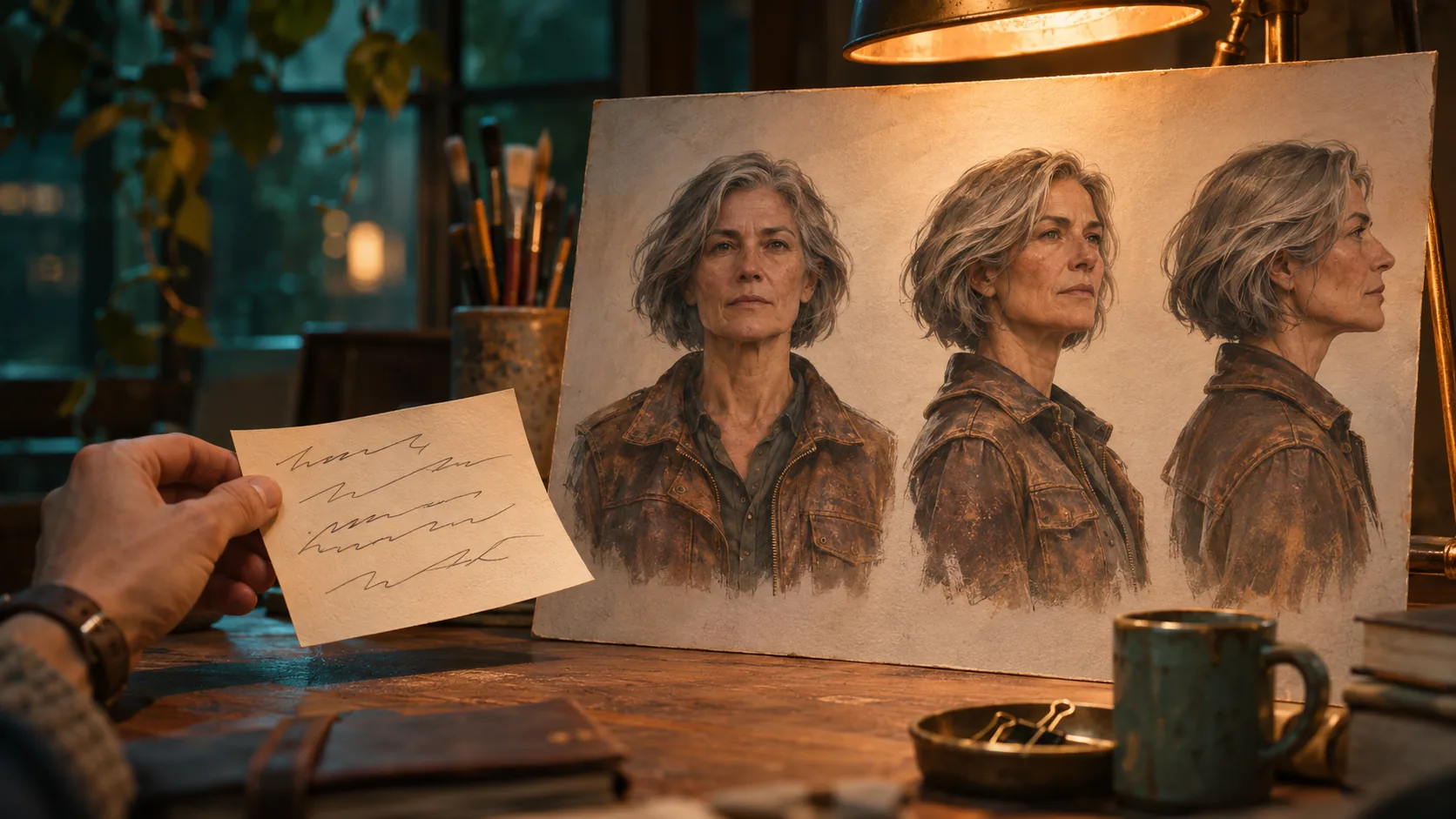
From description to a fixed character

There is no form to fill in. You talk to the agent and the cast comes out of the conversation, one character at a time if you want it that way.

  1. 1
    Give it the description, or the idea

    Paste a description you already wrote, or give a story idea and let the agent write the cast. The profile is written from what you said, so the details you gave are the ones that get written down.

  2. 2
    Read the profile

    Each character gets a name and a written description in the script: appearance, clothing, colours, materials. Read it and change anything by typing, for example “older, with a grey beard”.

  3. 3
    The sheet is drawn

    The description becomes a landscape 16:9 character sheet, so the face, the build and the clothes are visible together. If you upload a photo instead, the photo is used as the character and ranks ahead of anything generated.

  4. 4
    Change a detail, not the character

    Wardrobe, hair, facial features and signature items can be edited in place. The change is saved as a new version of that one character. The pictures that no longer match are listed and kept, and nothing paid is redone until you ask.

  5. 5
    Add a look

    A change of clothes, or the same person at an earlier age, is a variant. A variant keeps the identity of the main sheet, so you describe only what differs.

  6. 6
    Use the character

    The sheet goes with the character into every shot. When you start the next episode, the approved cast is reused rather than redesigned.

Vague versus drawable

A description works when two different artists, given only the words, would draw people you would call the same person. These are starting points for rewriting a line of your own.

VagueDrawableWhy the second one works
A tough womanA woman in her fifties, broad shoulders, a nose broken once and set slightly left, grey hair cut to the jaw, a worn leather work jacketFace, build, hair and clothes are all fixed. “Tough” is left to the performance.
A friendly old manSeventy, small and round, a white moustache yellowed at the ends, a cardigan with two mismatched buttonsA mismatched button is a detail a picture can hold.
A mysterious strangerA man with a long pale face, a black coat too big in the shoulders, a silver ring worn on the left thumbThe mystery belongs to the story. The look is specific.
A cool teenagerSixteen, thin, a bleached fringe over dark roots, an oversized green bomber jacket, white trainers scuffed at the toeAge, hair, one strong garment and one worn detail.
A scary villainA tall man in a pale suit, slicked grey hair, very still hands, one cufflink always undoneMenace comes from one odd detail, not from a scowl.

These are our own examples, written for this page.

What the description should carry, and what it should not

A character sheet can only show what can be seen: face, build, hair, clothing, colours, materials and one or two signature items. Those are the parts of a description worth spending words on, and they are the parts that get drawn.

Personality, history and motive are not wasted, but they do a different job. They live in the script and the story, where they decide what the character does and says. The sheet will not show that a person is shy; a shot of them standing at the back of a room will. Reelfo writes what a short drama needs, which is who the character is on screen. It is not a generator of game statistics or world lore.

What one character costs

A character sheet is one image, and a variant adds one more. The price is the image model’s price in credits; a credit is $0.0025 at the Starter plan rate.

Image modelCredits per imageIn dollars
GPT Image 2.56$0.01
GPT Image 29$0.02
GPT Image 2.6 Flare25$0.06
GPT Image 2.6 Sunburst25$0.06
Seedream 5.0 Pro36$0.09
Nano Banana Pro40$0.10

List price at the Starter rate, read from the same pricing the checkout charges. The model that draws the sheet is the one chosen for the project.

From one character to a series

A fixed character matters most when the story keeps going. Start the next episode and the approved characters, locations, props and style are reused, not redesigned, unless you ask for a change. The description you wrote in episode one is still the description in episode five.

That is the difference between a description that is read once and a description that is kept. If you are planning more than one episode, the story continuer page covers how the next episode is started.

Trying it free, and what free covers

Signing up puts 100 credits in your account, once, with no card. For a typical short story that is enough to go from your idea to a storyboard — the story brief, the script, the cast images and the shot plan — or, if you would rather, about 16 images in the image studio. A longer script or a bigger cast can use it up first, and the video itself is bought with credits.

A character sheet costs one image, so writing a description, drawing the sheet and redoing it a few times is well within the grant. The grant is not unlimited and it does not renew, and the video itself is bought with credits at posted prices.

Reelfo does not stamp a watermark on anything it renders. The compose step copies the video stream through untouched — there is no overlay filter in the pipeline to apply one.

FAQ

Frequently Asked Questions

Related

You might also like

Start creating today

Sign in and your first 100 credits are already there — no card needed.

Character Description Generator — Words to a Fixed Look | Reelfo