Sign up free — 100 credits, no card

Random Character Generator

A random character generator usually hands you a name, an age and three adjectives. This one hands you a person: a written profile, a character sheet drawn from it, and a place in a story you can turn into a short drama. Leave the brief open and let the agent invent, or fix the parts you care about.

Image
How It Works

Key Features

01

Leave it open, or fix what you care about

Say nothing about the character and the agent invents one to fit the story. Say "a retired stunt double who is afraid of heights" and it builds the person around that. Anything you do not decide stays open, and you can ask for another take.

02

A drawn sheet, not a paragraph

Every character is drawn as a landscape 16:9 character sheet from the written profile, so you see the face, the build and the clothes before anything is filmed. An outfit change is its own variant with its own sheet.

03

Ready for a story

The character is not an export you carry somewhere else. The same sheet is attached to every shot they appear in, so the person you generated is the person who ends up in the short drama.

What most random character generators give you

Most random character generators are dice with a vocabulary. They roll a name, an age, a job, a flaw and a quirk, and print them in a box. That is a good start if you play tabletop games or you are stuck on a blank page, and it is exactly as far as those tools go: a line of text you still have to turn into a person.

The next step is the hard one. A face has to exist. The same face has to exist again in a different room, in different light, a week later. A written description does not hold that on its own; two generations of "a tall woman in her forties with grey-streaked hair" are two different women. This is why people who write stories with generated characters end up with a folder of images that do not match.

Reelfo starts from the other end. The character is a profile that a story needs, a sheet drawn from that profile, and an image that travels with the character into every shot. "Random" here means the parts you did not decide are decided for you, in a way that fits the rest of the story.
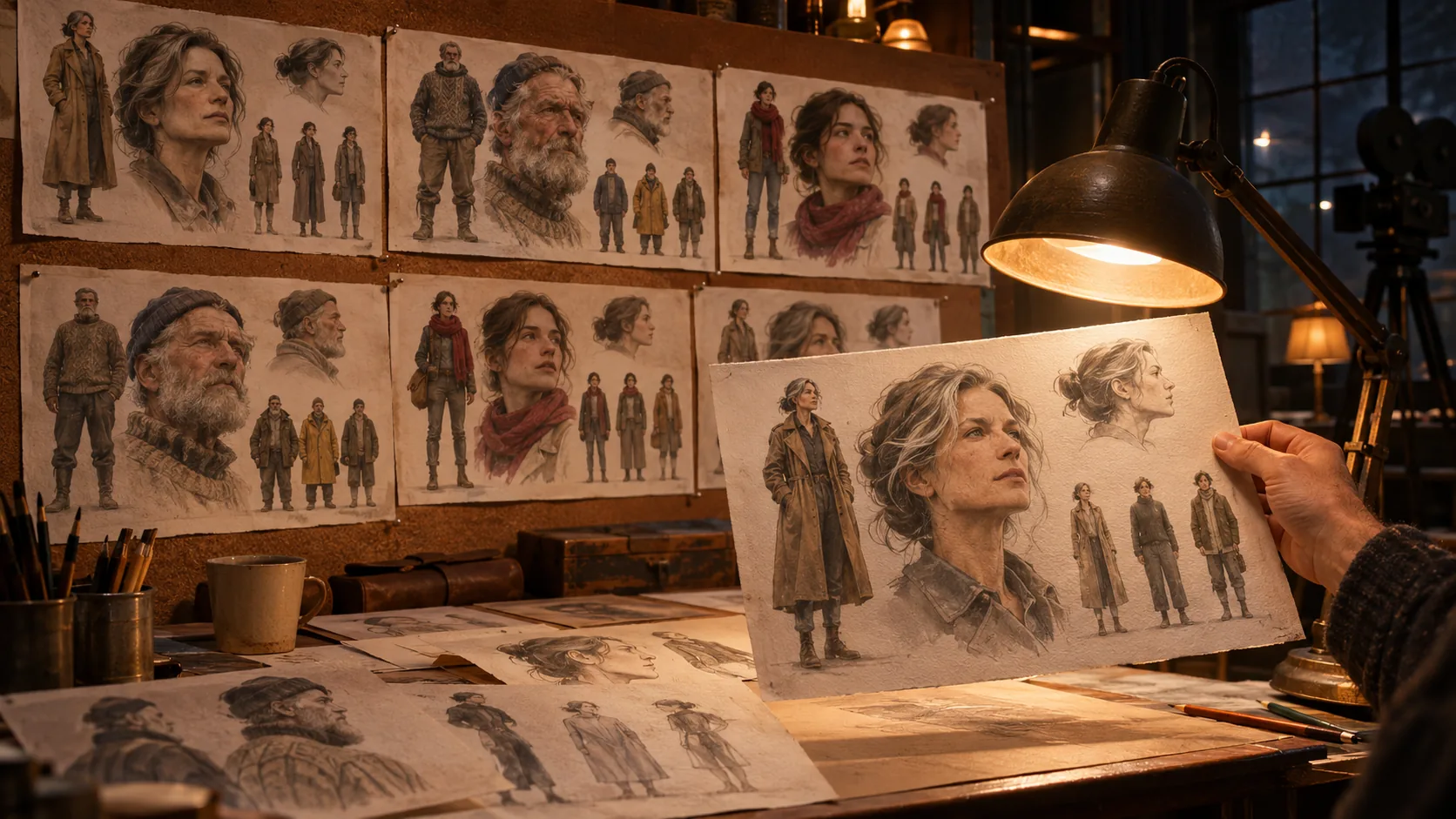
How a character gets made

There is no dice button, and no form of forty dropdowns. You describe a story in the chat, as loosely as you like, and the characters come out of it.

  1. 1
    Describe the story, or just the character

    One line is enough: "a heist comedy about two siblings", or "a lighthouse keeper who talks to the sea". If you want a character and no plot, say so. What you leave out, the agent decides.

  2. 2
    The agent writes the cast

    Each character gets a profile in the script: name, age, build, face, hair and clothing, written so a picture can be drawn from it. Read them and change anything by typing — "make her older", "give him a beard".

  3. 3
    A character sheet is drawn

    The profile becomes a landscape 16:9 sheet. If you already have a face you want, upload a photo instead: an upload takes precedence over anything generated, from then on.

  4. 4
    Ask again until it is right

    A character that is not right is an image to redo, not a project to restart. Change the description and draw the sheet again; the story and the other characters stay as they are.

  5. 5
    Put them in a story

    The sheet is attached to every shot the character appears in. From here the character is part of a short drama: script, storyboard and video are the next steps, and each one is priced before you spend.

What one character costs

A character sheet is one image, and an outfit variant adds one more. The price is the image model's price, in credits; a credit is $0.0025 at the Starter plan rate.

Image modelCredits per imageIn dollars
GPT Image 2.56$0.01
GPT Image 29$0.02
GPT Image 2.6 Flare25$0.06
GPT Image 2.6 Sunburst25$0.06
Seedream 5.0 Pro36$0.09
Nano Banana Pro40$0.10

List price at the Starter rate, read from the same pricing the checkout charges. The model that draws the sheet is the one chosen for the project.

Random character ideas by genre

Starting points, not outputs: seeds you can paste into the chat and let the agent build out. Each has something the character wants and something that gets in the way, because that is what makes a character usable in a story.

GenreSeedWhat they wantWhat gets in the way
Heist comedyA retired stunt double who plans jobs from a hospital bedOne last job that does not need her kneesHer crew only trusts her when she is lying
FantasyA lighthouse keeper on a coast where the sea speaksTo be told what the sea wantsIt only answers in other people’s voices
Sci-fiA salvage pilot whose ship has outlived three ownersTo sell her without losing the ship’s memoryThe buyer is the ship’s second owner
RomanceA wedding photographer who has never been in a photoTo be seen once, by someone who staysHe knows every angle that hides him
HorrorA night-shift cleaner in an office tower that has one floor too manyTo finish the shift and keep the jobThe extra floor is always clean already
ThrillerA court interpreter who hears what the defendant says before the translationTo stay invisible in the roomShe just heard a confession nobody else understood
Family dramaThe middle sibling who runs the restaurant their father is sellingTo keep the kitchen as it isEveryone else wants the money
MysteryA radio host who reads a missing person’s name out every nightAn answer before the station closesThe only caller is the missing person

These are our own examples, written for this page.

Trying it free, and what free covers

Signing up puts 100 credits in your account, once, with no card. For a typical short story that is enough to go from your idea to a storyboard — the story brief, the script, the cast images and the shot plan — or, if you would rather, about 16 images in the image studio. A longer script or a bigger cast can use it up first, and the video itself is bought with credits.

A character sheet costs one image, so generating and redoing a few is well within the grant. The grant is not unlimited — a longer script or a bigger cast can use it up before the storyboard — and the video itself is bought with credits at posted prices.

Reelfo does not stamp a watermark on anything it renders. The compose step copies the video stream through untouched — there is no overlay filter in the pipeline to apply one.

FAQ

Frequently Asked Questions

Related

You might also like

Start creating today

Sign in and your first 100 credits are already there — no card needed.

Random Character Generator — Cast Sheets You Can Film | Reelfo